We write our own software, and AI is part of our daily production work — under one rule that does not bend: AI proposes, a person decides.
BIOCARD UAE is part of the international BIOCARD Group, whose specialist heritage in temperature logistics dates to 1989. The platform that runs our shipments — the transport systems, the quality systems, the sensors and the monitoring portal behind SafePack — was built by our own engineering team. We did not buy it in, and we do not resell anyone else’s product. It is ready to be deployed for clients and partners beyond the markets where we operate it today.
Why this page matters to a cargo owner: the quality of your shipment is decided by the system that plans it, watches it and proves what happened.
Most logistics software is written by people who have never had a shipment at risk.
Our software is written inside the company that owns the containers, the sensors and the quality function. Our engineers work inside the operation, alongside the people who dispatch the vehicles and sign off the temperature records. When a feature is wrong, it does not become a backlog item — it becomes a problem someone has to answer for. That feedback loop is why the product looks the way it does.
This is consistent with how BIOCARD works in general: we keep more of the chain in-house than most operators do, and technology is part of that. We do not sell presentations. Everything described on this page runs inside a company that has been moving temperature-sensitive cargo since 1989.
What that changes for your shipment:
See how that shows up in practice: monitoring and shipment reports and SafePack thermal packaging.
These are live figures from our own development system, as of 30 September 2026.
We publish them because capacity is easy to claim and hard to fake. The point is not the size of the catalogue. The point is that the systems are maintained daily by people you can talk to, rather than frozen at the version that was sold. All figures below are as of 30 September 2026 and change over time.
19,026 changes were recorded across the estate in the 60 days before 30 September 2026. It is a measure of how actively the estate is maintained. Figures are read from our own GitLab; we date them because an undated number stops being true within a month.
Each one was built for our own operation first and is in production today.
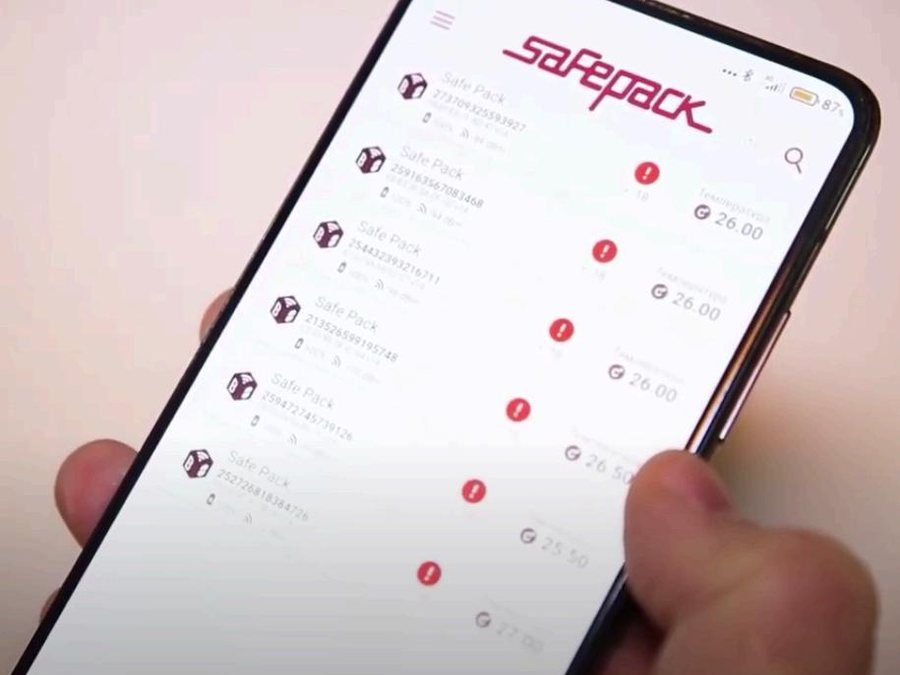
Our own thermal containers, our own sensors, data-collection gateways and a monitoring portal. The sensor records temperature, humidity, shocks and light (a sign of opening) along the whole route; the data is read over Bluetooth without opening the box, and you get a full-route temperature report. SafePack holds temperature for up to 96 hours under defined conditions.
A request lives in a case — client, shipment, deadline, owner, evidence — not in a chat thread. Deadlines are recalculated automatically, escalation raises itself, and the decision history stays immutable.
Operational and quality reports computed straight from the database that holds the data, published in a catalogue with access rights. One version of the number, with the source traceable.
Versioned message contracts, one exchange bus with delivery guarantees and end-to-end tracing, and a live map of the exchanges. Integration is the part most projects underestimate; it is where much of our engineering goes.
People, tasks, code and services in one picture: who worked on what, where it stalled, what changed and what it affected. Plus a passport for every service — what it does, where it runs and what it talks to.
A sixth system handles electronic transport documents, built to a national regulator’s mandatory format in another market. It is market-specific and we do not offer it in the Gulf. We mention it only as evidence that the team can build to a regulator’s requirement and keep it running.

The full product catalogue, with what each system does and how it is deployed, lives on our technology site: more about the products at biocard.tech →
AI here is not an experiment. It is in daily production use, under a rule that does not bend.
Today AI works in production in our Service Desk: it drafts replies to client enquiries and case digests from the case history and the evidence attached. An agent reads the draft, corrects it if needed, and sends it. The decision and the sending always stay with a person.
We are extending that way of working to other routine preparation inside our systems. We will describe each new use on this page when it is running in production and not before — a claim about AI is worth exactly as much as the day it becomes verifiable.
The guardrail. AI never executes an irreversible action. It does not release a shipment, close a quality case, confirm a document or change a record on its own. Anything that cannot be undone is done by a named person, and the approval is logged. This is not caution for its own sake: in a regulated cold chain, an automated decision nobody can be attributed to is a finding waiting to happen.
Where data must not leave the perimeter, we run language models on our own hardware rather than sending the content to a third-party service. Nothing leaves the perimeter, and the cost per request does not depend on someone else’s price list.
Your operational data stays yours. Where the data is physically stored for a deployment is a market-specific question — it is answered and written down during scoping, before any deployment work starts, because the answer differs by jurisdiction and by client policy.
If your quality or IT function has a data-residency requirement, bring it to the first conversation rather than the last. It shapes the architecture, not the paperwork.
We would rather be precise about this than oversell it.
| Travels to your market | Has to be done locally |
|---|---|
| The platform and its services. SafePack containers and our sensors. Integration patterns for ERP and accounting systems. The AI guardrails. The operating methodology behind all of it. | Regulatory documentation and validation protocols. Local data-storage requirements. Customs and transport document formats. Language and interface localisation. |
The platform, the containers, the sensors and the working methodology are not tied to any one country, and nothing in the architecture assumes a particular market.
Regulatory documentation does not travel. Every market has its own authority, its own expectations for qualification and validation, and its own rules on where data may be stored. We do not claim that paperwork written for one regulator is valid for another. What we bring is a system built to satisfy a regulator, plus the people who did it — the local qualification is completed together with your quality function. How we work with quality teams is set out on Quality and compliance.
We do not quote a timeline before step two. A timeline given before we have seen your systems would not be worth much.
A working session with the engineers who built the systems, on live screens rather than slides. Bring your IT and your quality people.
We pick one process, map the data sources on both sides, agree where the data will be stored, and state explicitly what AI may propose and what only a person may do.
One lane, one site or one process, with success criteria agreed in writing before it starts. Scale is decided on the result, not on the proposal.
The sequence is deliberately small at the start. You should be able to judge us on working software before any commitment of scale.
Bring a real process and real systems, not a general enquiry — the first session is more useful that way.
Related pages: Temperature monitoring and reports · SafePack thermal packaging · Quality and compliance.
Tell us about the shipment. A BIOCARD specialist will review the route, temperature requirement and shipment details before responding.